Wednesday, February 5, 2014

Money Matters

I haven't written on here for awhile, so will try to do better.
         Today, I will write about how money is different in Tanzania.
First of all, we use shillings instead of dollars.
 
Other than looking different, money is money. One other difference is that the largest bill is a 10,000 shilling note.  Which is worth around $6.  So, you can imagine when we take out a few hundred dollars at the ATM, we feel like millionaires with wads of cash!
         The exchange rate for dollars to shillings is one dollar is worth 1630 shillings.  Which means the Tanzanian economy is really bad.  The Kenyan shilling is much better- one dollar is worth 80 Kenyan shillings.  So, you can see how much further behind the Tanzanian economy is than Kenya.
     One thing about money here is that we pay all of our bills in cash (rent, utilities, internet), in PERSON.  The bill is either e-mailed to us, or usually delivered to our house in person.  We don't even own a checking account in the country, but just pull out cash with an ATM, since checks are rarely used as a means of payment for anything.  One reason that bills are hand delivered to your house is that there is no home delivery for mail here.  Having a post box is the only way to receive mail, and the person billing you doesn't trust that you have a post box or that you gave him the right address.  So, they send someone to your house with a bill.
      There are a few fancy stores and restaurants in town that accept credit cards, but most of the country works on a cash basis.


Tuesday, January 7, 2014

Weather

I am going to write about weather today, because right now, many of our family and friends are in the mist of blizzard-like conditions in the mid-west.  And right now, it is 84 degrees in Arusha. :)  Which is why I live in the tropics.

 This....    OR
This?


    Weather is a huge selling point to me for living in Tanzania.  I *dislike* cold weather, snow, sleet, hail, and freezing rain.  When it drops below 60 I feel chilled.  Which is one reason I really enjoy the weather in Tanzania.  Arusha's temperatures usually stay between the 70's and 80's YEAR  ROUND.  It might be a rainy season, or dry season, but the temperature is always moderate.  The hottest month of the year is February, the high being about 87 degrees.  The coldest month of the year is July, which might dip down to 55 degrees at night (BRRR!) 

    One outcome of the consistent weather is the way houses are built.  The windows are all single paned, and usually have noticeable spaces around them letting air in and out.  Most Tanzanian homes that are made from concrete have a concrete block in each room near the roof with holes in it, "to let the air in" from the outside.  Not much thought (or any) goes into insulation. 

   Because we live so close to the equator, the daylight is consistent year round.  The sun comes up around 6AM and goes down around 6PM, only fluctuating about a half an hour throughout the year.  There is no dismal winter afternoons where the sun goes down at 4PM, and no summer nights that last until 10PM.  Personally, I like that. 
    Since we are so close to the equator, we have to be very careful to not get sunburned, and wear hats, sunglasses, and sunscreen when we go out.  It's common to see many children coming out to play, and adults going for a walk around 5 PM, twilight, when the sun isn't as intense.

      All in all, I have to say, the weather in Arusha is lovely.  We have very few thunderstorms (maybe three since we've been here), too far from the coast to worry about hurricanes, and as far as I know there aren't tornadoes in Tanzania either.
        Have a nice day, and stay warm!

Thursday, November 21, 2013

Electricity

Since we are in the middle of 24 hour power cuts with 12 hours of power between, power is on my mind.  By power I mean electricity. 
    Electricity in Tanzania is different than in America on several levels.

First of all, the power is 220 volts not 110 volts.  Now, I really don't know what that means except to say that you can't use electric appliances from America with the electricity in Tanzania without using a transformer- unless it specifically says 110-220 volts on it.
  
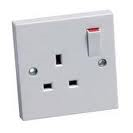
 The outlets are different here.
            The shape of the plug that can fit into the outlet is different.  So, even if your appliance is 110-220 volts, you would have to have an adapter to plug it into the wall.  We usually use an extension cord that has the correct outlets on it.  To confuse things even more, many appliances that you buy here are from China or South Africa which have a different plug again.  So, our house has many types of adaptors.

        Also, there is a power switch on the power outlets.  You can switch off the power at the wall without unplugging the appliance, which is nice. 

     Another difference is that for some reason, all the light switches for the bathrooms are on the outside of the bathroom.
  
The red switch turns the instant hot water heater on both of the showers in our house.  Most people here don't have hot water heaters, but the few that do usually only turn them on a little while before they want to use the hot water to save power.  We have an instant hot water heater that heats the water as it comes of the shower.  Unfortunately, we get shocked if we touch the tap while it is on, so we have to turn on the shower, then the heater, then after our shower, turn off the heater, and then turn off the water.  Something is wrong with the grounding in the house, I think.
      
         Another difference is that there are two types of light bulbs and sockets here:


Pin type light

Screw type light
 
  All the houses we've lived in here, which are many, have had both types of sockets in them.  So, we have to have both type of light bulbs.  Don't ask why.
 
 
    The biggest difference though, is that we are often without power.  It is rare for us to go a week without losing power for several hours.  Right now, they are working on the power grid, so for 10 days we are without power for 24 hours, and with it for 12 hours, and so on. 
     Not being able to rely on power makes you modify things a bit. First of all, I have to have a gas stove/oven.  That ensures that dinner won't be ruined if the power goes off while I'm cooking.  We have a generator to recharge our phones and computers when they run low.  I only let the kids have 1/2 hour of computer time a day, so they are used to entertaining themselves without power.  They really don't notice it if we lose power during the day.  We have candles and kerosene lanterns for nights if we don't want to run the generator. 
     Those are some of the differences between Tanzania and America when it comes to power.  To be honest though, most people here don't have power at home.  So, when there is a power outage, it doesn't affect them at all!

Friday, November 15, 2013

Time

        I am starting to write more on this blog not just about the kids, but also what it is like to like in Tanzania.  People often ask me, "What is different about living in Tanzania?"  The answer is "Everything."  Nothing is the same.  I want to use these blogs to show just a window into life in Tanzania.  When you are in a culture, you are experiencing everything at once: sights, sounds, weather, food, language, people, smells, etc.  I will attempt to discuss one thing at a time.

              TIME


       For starters, there is Swahili time.  And, I'm not talking about being perpetually late (more on that later).  The way they tell time is literally flipped from the way we do.  7 am to them is 1 o'clock, 4 pm to them is 10 o'clock.  Is your mind spinning yet?  It actually makes a lot of sense.  We live near the equator, so the length of days only fluctuates about 1/2 hour all year.  Which means that it is very easy to tell time by looking at the position of the sun in the sky.  Which is what they do.  1 o'clock in the morning, means that the sun has been up for one hour (it is 7 am).  Saa sita (The sixth hour), means the sun has been up for six hours, is right above you, and it's 12PM.  This way of telling time actually makes sense when you think about it.  And, it's how the Israelites told time in Bible times.


         Ok, now onto "African time".  Usually, we can only make one appointment a day, because you are never quit sure when that person will show up.  Our evangelist will often show up two hours late from the time he said he will come.  We learn to expect this, and not to plan too much into one day.  The reason for their lack of promptness has to do with their culture.  If the person has a prior engagement, it would be rude of them to break it off early, or to interrupt the flow of that event to reach you at a specific time.  Once they come, however, they usually will stay and visit for hours.
        Being exactly on time isn't as important as the event, and spending time with people is of utmost importance here. 
       For instance, church starts around 9:30.  That is when the pastor's family and a few others meet in the church and pray and start to sing.  When the neighbors here the singing, it reminds them that church is starting, and they start to get ready.  People slowly come in, and by 10 AM, most people are there.  But, once there, they are THERE.  The service lasts 2-3 hours, including an hour long sermon and an hour of singing, plus a mini-sermon for the communion.  After church, no one rushes off, but everyone stays around for another 45minutes to an hour just talking and catching up. For them, church is an EVENT, not something to rush through.  They enjoy their time together.
            In America, we are notoriously late.  And, I am often shocked at how short the church service is, and how people run off afterwards.  Maybe Tanzania is rubbing off on us.

Wednesday, November 13, 2013

Food Part Four: Drinks

  My last post about food is about drinks.  One important note about Tanzanians and drinks. They do not like cold drinks.  They believe that drinking cold drinks (or eating cold food for that matter) will give you a cold.   They would think Americas were absolutely crazy to eat cold icecream outside while picking out Christmas trees (which my family has done at Ted Drews in St. Louis). 

                      Ok, so the most common drinks are:

                          Chai (Tea)- Usually drunk with milk and sugar, sometimes masala (mixed spices like cinnamon, cloves, black pepper, ginger, and cardamom) is added for flavor.  Drunk several times a day.
                                                 Mtindi-  A cultured milk drink

                  Of course, there is always water, but often water here is not safe to drink unless boiled, which may be why chai is so popular.
        
    
Coke, Fanta and Sprite are very popular, usually drunk at room temperature from the bottle.  We still use glass bottles here, which are collected and then filled again at the bottling plant here in Arusha.


Many people enjoy coffee... ironically, this is where coffee is grown, and the WORLD'S BEST COFFEE comes from Arusha, but it is all exported.  To buy N'gamba Peaberry, you have to buy it re-imported into the country, so it is a little expensive.  So, most people here just drink Africafe, an instant coffee.  Like I said, ironic.
 
And, of course there is alcoholic beverages, but I won't go there.  That's all for today!

Tuesday, November 5, 2013

Food Part Three: Snacks

Tanzanians usually will eat something light in the morning, like uji (a corn/milk porridge you drink), left over chapatti (thick tortillas) or sliced and fried ugali (cooked corn meal), or bread and tea; or else they will skip breakfast altogether.  The main meal of the day is eaten anytime between noon and four, but depending on what is happening that day.  That is when they eat what I posted last time.   The evening or final meal is left overs or something light like chapatti or bread eaten right before bed.  Others may eat the main meal at night if they can't be together during the day.

Katrina (front) drinking uji with the other children at language school preschool.

    Since the meals can be up to 8 hours apart, eating a small snack is normal.  School children walking home from school will be seen buying chips or mandazi from the side of the road.  They may have skipped breakfast or had something small, and most schools don't offer lunches so they are really hungry on their way home from school!  They will eat their "dinner" as a family once the family has all arrived home from school, the fields, and any jobs.

           Typical snacks include:


Mandazi- donuts


Roast Corn

Sugar Cane

Dagaa- Tiny, dried fish

Udongo- literally dirt, especially craved by pregnant women

Chips (fries)

Samosa (fried bread with meat or vegetables inside)

Bananas


Saturday, October 19, 2013

Food Part Two: Meals

Last week, I wrote about food, and this week I am continuing with typical Tanzanian meals. 

 
   Rice and Cabbage (shredded and stir fried with shredded carrots)
 

Ugali (White corn meal boiled until solid) and Spinach (stir fried with onions, tomatoes and carrots)
 
Ugali is the national staple, sometimes made with Cassava flour, a tuber that grows locally.
 

Chapati (a thick tortilla) and beans (made with green peppers, onions, carrots)


Rice and Beans
 

Pilau (Beef or chicken cooked together with rice and spices like cinnamon, chilies, cumin, garlic, coriander, and cloves)  Usually the meat is cooked in pieces on the bone
 
Chips Mayai (An omelet made with Large cooked fries) served with salt and chili sauce.
 
Kuku na Chips (Chicken and Fries)

 Fish and Chips (Fries)

 Mishkaki (Meat kabob), chips and salad (shredded cabbage and carrots with vinegar)
 
Supu (Soup- can be made with out with out beef or chicken- potatoes, carrots, and corn

Plantans fried, or they can be cooked into a stew
 
 
Next week, Snacks!


Our family

Our family